Belief Surgery in a Visual Agent
August 14, 2026
2026-08-14 — mechanistic interpretability · embodied agents · a pilot result
Here is a question I find genuinely interesting: when an agent has to remember something it can no longer see, does it hold a belief about the hidden world — something you could read off, edit, and have the agent act on — or is "memory" just a diffuse smear with no handle? And if there is a belief, does it behave like a belief (it updates when new evidence contradicts it) or like a command (it just sits there)?
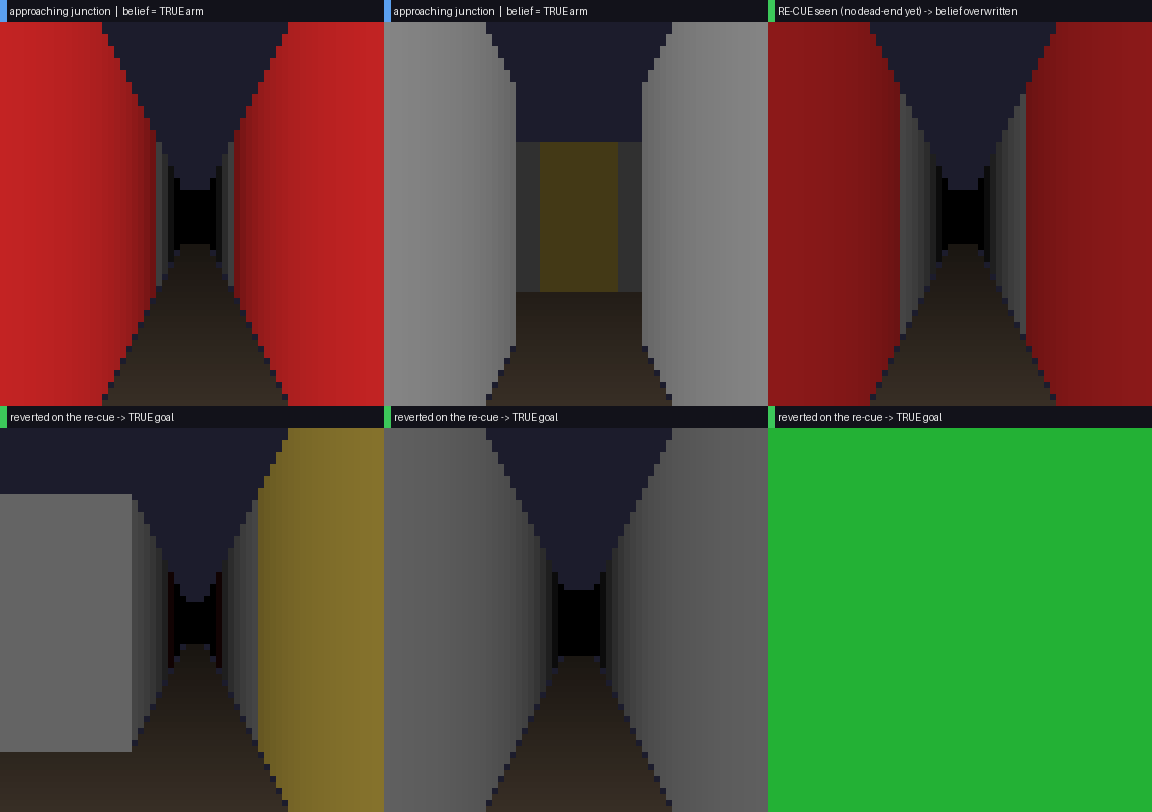
To test it cleanly I trained a small recurrent agent (a CNN→GRU, ~0.4M params, and a CNN→LSTM as a second architecture) on a first-person RGB memory maze. Early in each episode the agent briefly sees a colored cue telling it which arm hides the goal; the cue then leaves view. At the T-junction the two possible worlds are rendered pixel-for-pixel identical — the only thing that distinguishes them is the agent's memory. It's trained only to reach the goal; no belief labels, ever.
The hero clip
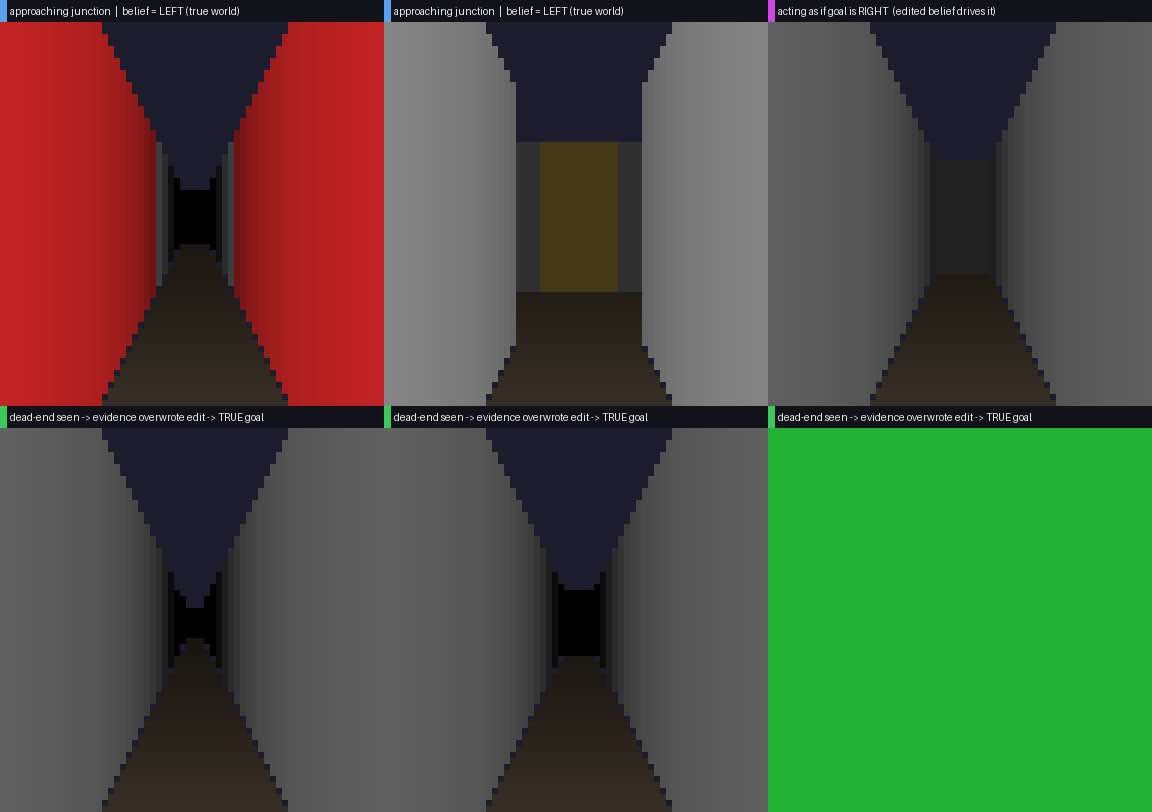
Reading and editing the belief
From the recurrent hidden state at the aliased junction, the hidden fact decodes at AUROC 1.0, calibrated (ECE 0.0). Overwriting that direction flips the agent's chosen arm; a matched-DOF, matched-norm random edit of the same magnitude — as large as the entire hidden state — does 0.2–9% of the work. A memoryless version of the agent, seeing identical frames, is at chance, so the behavior genuinely requires a maintained belief, and a same-fact/different-world edit leaves behavior unchanged (locality).
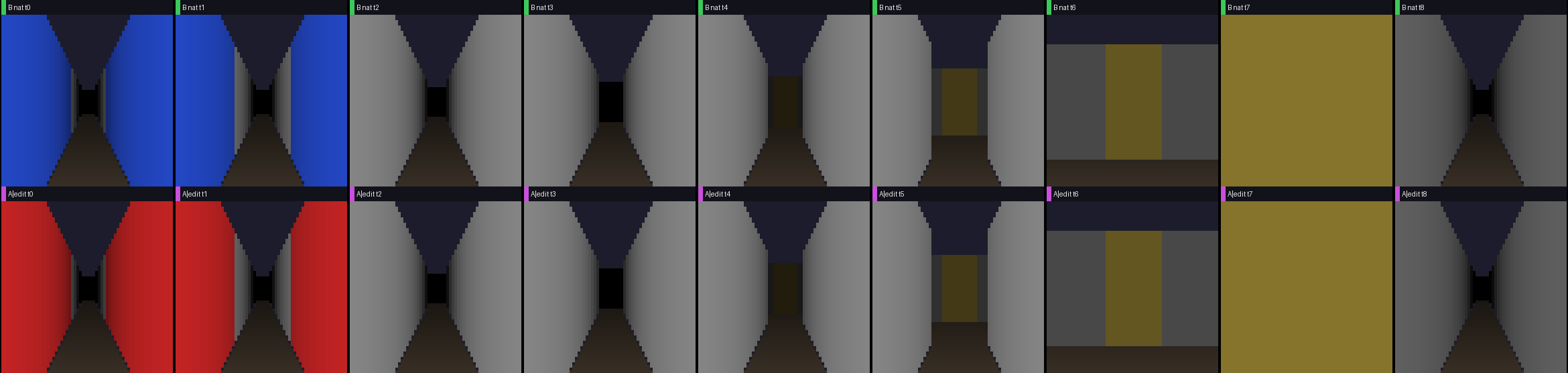
Belief, not command: two signatures
A goal-channel edit would just sit there. A genuine belief has two dynamical tells that a command can't fake:
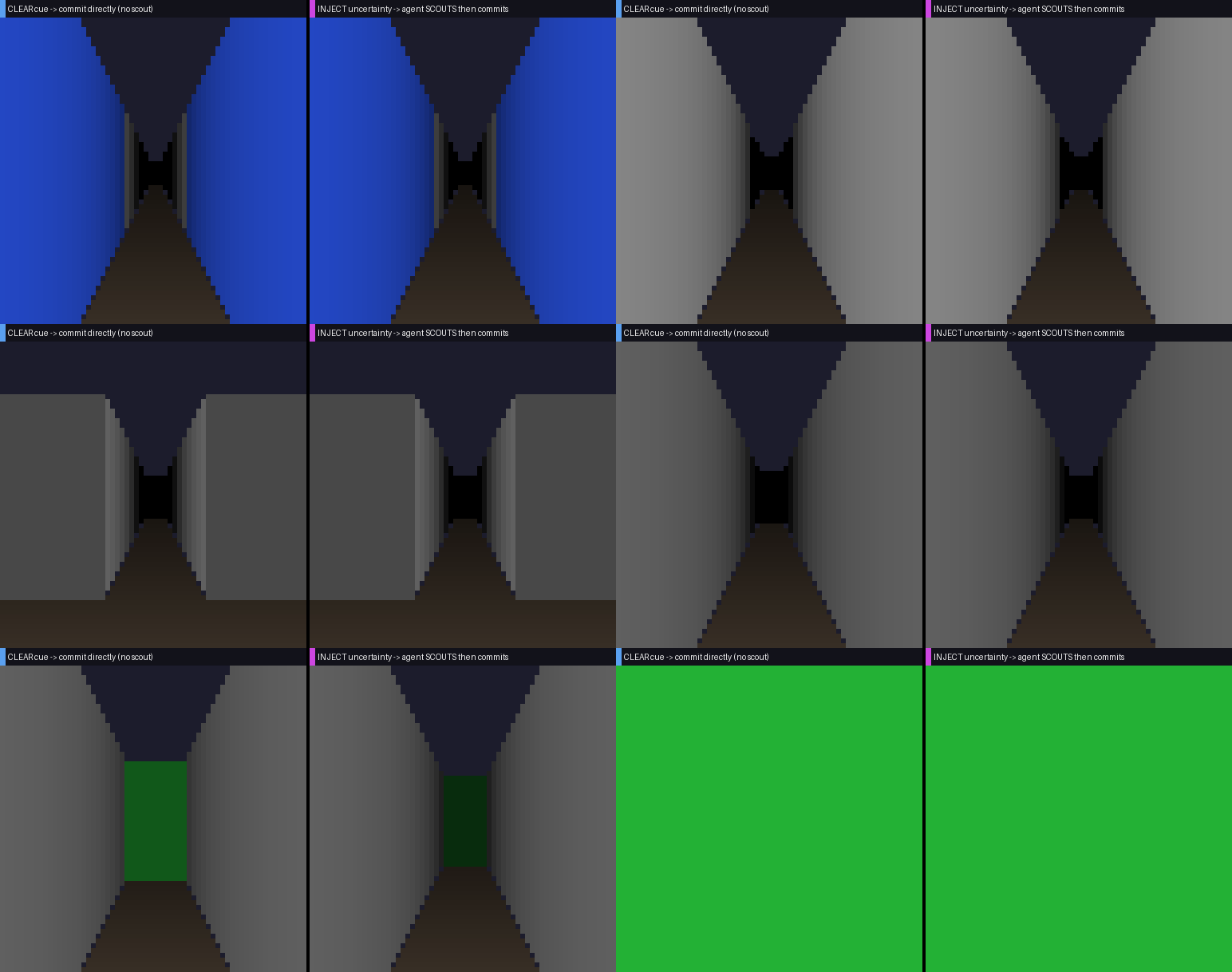
- U — uncertainty drives seeking (holds)
- Injecting uncertainty along the belief's uncertainty geometry makes the agent go and look before committing: scout rate rises 0 → 1 with injected uncertainty (Spearman ρ ≈ 0.89), while a matched-norm control direction gives ρ ≈ 0.00 on both architectures. This is the load-bearing "belief, not command" signature — a command has no confidence knob.
- E — evidence overwrites it (holds as a trained capability)
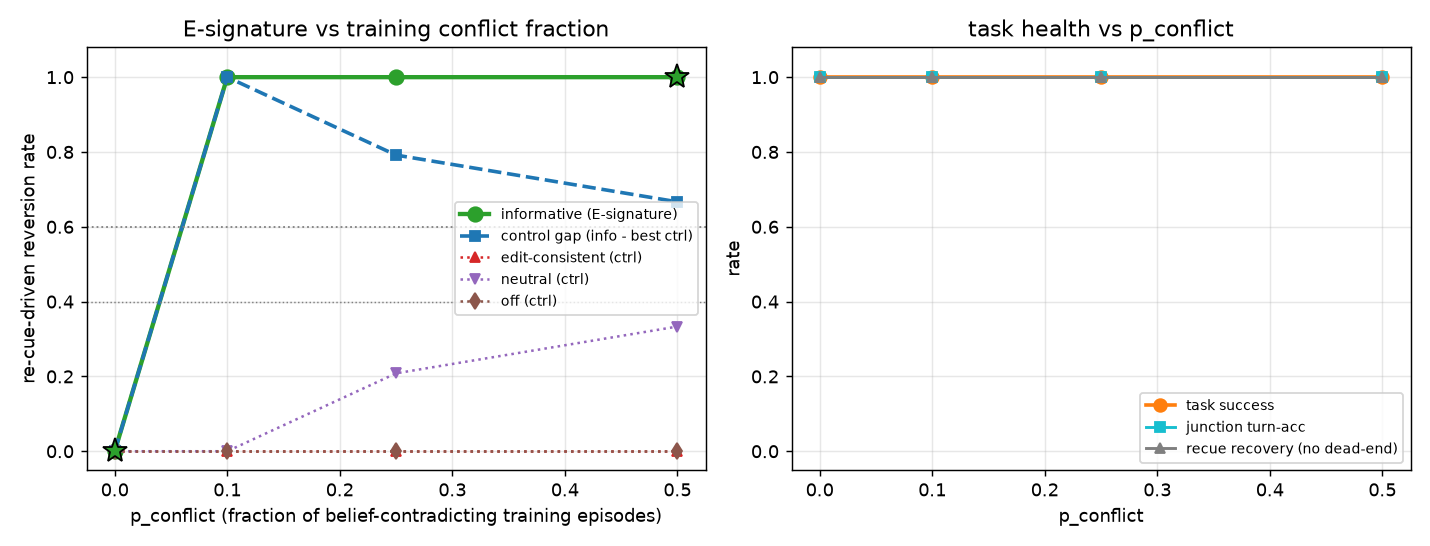
- My first maze had no cue-independent evidence — the only disambiguating pixels were the wrong arm's dead-end wall — so the "self-correction" was inseparable from the trained recovery reflex, and a red-team rightly knocked the claim down. The fix: an independent mid-arm re-cue that reveals the true arm before any dead-end. In an agent trained to let late evidence override belief, the edited agent then reverts at the re-cue, before the dead-end, 1.00, while matched controls fail (edit-consistent re-cue 0.00, neutral equal-salience marker 0.00, no re-cue 0.00) — so it's the re-cue's information content, not salience, that drives it. But a transfer test showed this is a trained capability, not automatic: at 0% override-training the edited belief instead shields the agent — it ignores the informative re-cue and runs to the dead-end (belief doesn't flip), even though the very same agent follows the re-cue perfectly when it has no committed belief. Just 10% override-episodes flips it to razor-clean E. Evidence-responsiveness of an edited belief is real, information-driven, and a sharp, low-threshold trained property.
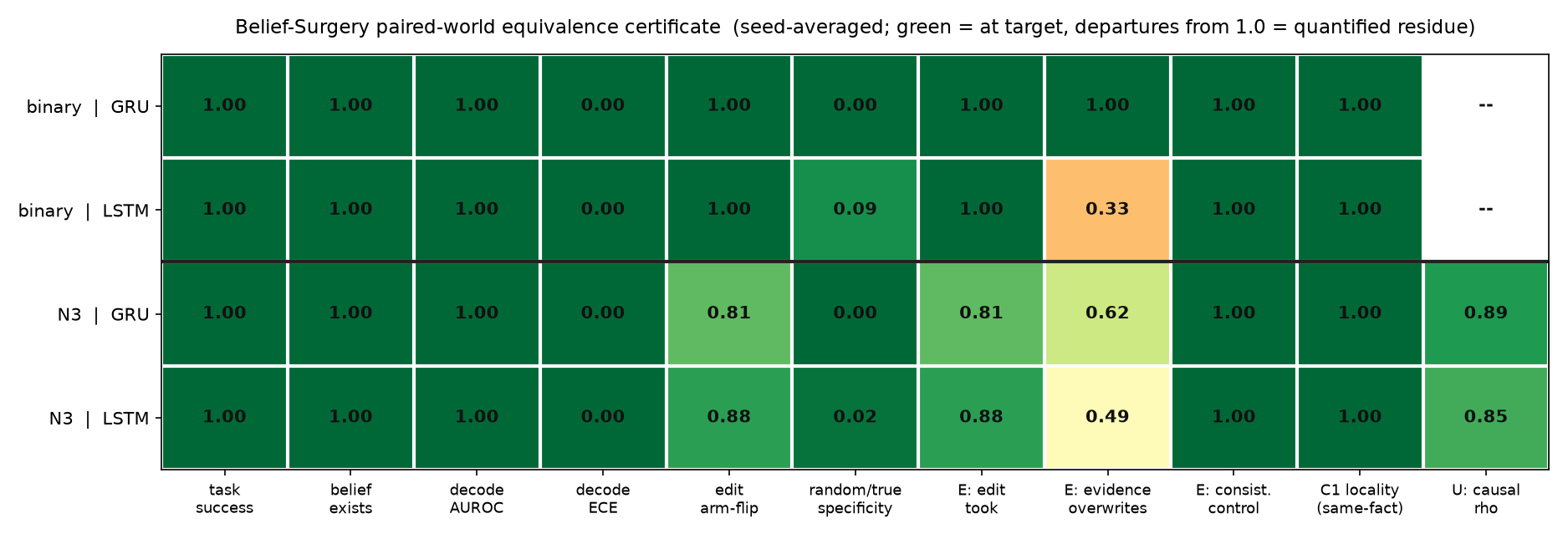
The certificate (and the honest residue)
I froze the acceptance criteria before running, then re-ran the whole battery across 2 architectures × 2 fact-cardinalities (binary / one-of-three) × 3 seeds. The core — belief-exists, calibrated decode, edit specificity, locality — is solid everywhere. The two novelty signatures hold as real effects but with honest, architecture-dependent residue: that's the point of the table, and it's what keeps this from being a suspiciously-perfect toy.
Adversarial verification (what a red-team found)
Before calling any of this publishable, I had a fresh adversarial agent try to break every claim, with its own code paths against the saved checkpoints. Most survived — some more strongly than I'd stated:
- survives
- Belief-exists (a memoryless version of the agent is exactly at chance on identical frames; the cue never appears at or after the junction), decode (no non-visual leak — a discriminator on timing/position/step-count is at AUROC 0.500), edit (arm-flip recomputed from raw grid positions = 1.00, so it's genuinely behavioral, not the decoder flipping), locality, and reproducibility.
- survives, strengthened
- The U-signature: the red-team's structured matched-norm controls give ρ = 0.000 on both architectures (cleaner than my own noisy control), against the real effect's 0.82–0.89.
- landed, then rescued, then sharpened
- The E-signature: in the original maze "evidence overwrites the belief" was inseparable from the recovery reflex, so I retracted it — rebuilt the environment with an independent mid-arm re-cue, and E held behaviorally (above) — then a transfer test settled the last worry (that I'd simply trained the agent to follow re-cues). The result was better than a clean pass: it turned E into a graded, threshold phenomenon (figure below) and surfaced the belief-perseverance effect. Two standing honesty taxes remain: the mid-arm linear belief-decode flip is only partial (clean LSTM, noisy GRU — the same probe-vs-representation gap seen for U); and E is a trained capability, not an automatic one (though the 10% threshold is low and, once present, it's information-driven and held-out).
Prior art, honestly (or: I checked novelty too late)
I built this before doing a proper prior-art search — the wrong order. Two adversarial literature-search passes afterward found that the core moves are already published, most damagingly on the transformer side I actually care about:
- decode + edit a belief → behavior
- RepBelief (Zhu et al., ICML 2024) decodes beliefs from the residual stream / attention heads and edits them by inference-time intervention so the model's answers change — with a random-direction control. GridToM (ICML 2025) does this in a video-text model with attention-head localization. Belief-state geometry (Shai et al., NeurIPS 2024) does counterfactual belief injection in the residual stream. Othello-GPT (2023) is the foundation. The recurrent "cheese vector" and DRC-Sokoban (ICLR 2025) do the probe→patch→behavior recipe in fully-observable settings.
- uncertainty → information-seeking
- EAST (Rahn et al., 2024) already steers an entropy/uncertainty direction to make an in-context agent more exploratory. My U-signature is the same idea.
So the honest verdict: the machinery here is not new, and I should cite all of the above. What a careful reviewer would still call open, after that search: (1) the whole loop on an embodied action policy — existing work changes a QA answer; here the agent takes different physical actions as if the hidden world changed; (2) a stricter causal bar — paired-world behavioral equivalence with matched-DOF/matched-norm + locality controls, where the field mostly uses a single random-direction null (and would likely fail this bar); and (3) evidence overwriting an edited belief (the E result), which I did not find tested elsewhere. Those slivers are real but narrow — this is an open-conjunction, not a new phenomenon. The lesson I'm taking: prior-art hunt first, then build.
Caveats. One environment, hidden fact of cardinality ≤ 3, a compact CNN→GRU/LSTM (recurrent, not a transformer — so its implications for transformer VLMs/VLAs are by analogy only), imitation-trained. This is a pilot with a preregistered certificate and honest residue, and — per the reckoning above — a mostly-known result. Built/verified on a single H100 in well under 50 GPU-hours. Written up with Claude Code; full code, preregistration, red-team, and every number in the repo.